


- Home
- Accomodation
Accomodation in France
THEY TRUST US





- Activities
- Tourism
Tourism in France
 Tourism Lyon
 Tourism Paris
 Tourism Marseille
+
Cultural places French Museum
 French monument
Vacation Seaside resort
 Winter sports resort
 Spa
- Tours
- Events
- Guides
- Car rental
Rent a car for your trip


- Blog



 Home
- > Outings France
- > Nouvelle-Aquitaine
- > Dordogne
- > Rouffignac-saint-cernin-de-reilhac
- > Grotte de rouffignac
Grotte de Rouffignac
An Immense Cave
The Rouffignac Cave is one of the largest caves in the region. It features approximately 8 kilometres of galleries, with passages of unusually large dimensions for the Périgord region. Spread over three levels, the galleries can reach heights of around 10 metres and widths of up to 12 metres.
The entire cave system was formed in Cretaceous limestone containing abundant flint nodules. Today, the network is almost entirely dry, apart from a small stream flowing through its deepest passages.
Most of the erosion that created these galleries occurred during the Tertiary geological period. The cave system is believed to have been dry for approximately 2 to 3 million years.
A Cave Once Inhabited by Bears
The first inhabitants of the cave were most likely cave bears. Their repeated visits left numerous traces, including countless claw marks on the walls and ceilings, as well as sleeping hollows (nests) in the clay floors of certain galleries.
Surprisingly, however, very few bones have been discovered. These bears belonged to a species that was already extinct by the time prehistoric artists arrived at Rouffignac.
The Arrival of Magdalenian Artists
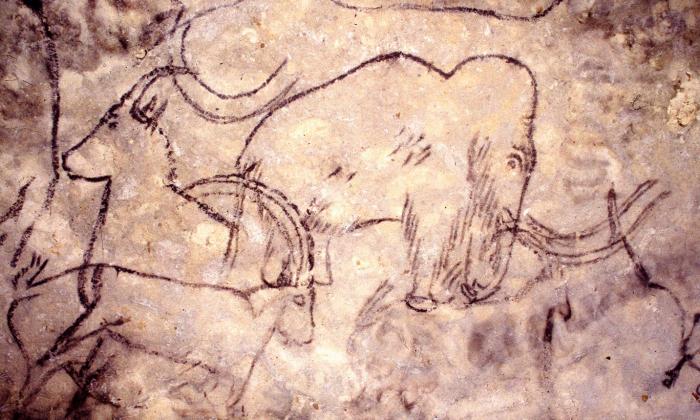
The mammoth is the dominant subject of the prehistoric artwork at Rouffignac. A total of 170 mammoths are depicted on the walls and ceilings of this vast underground labyrinth.
Despite the fascination that mammoths inspire today, they were relatively rarely represented by prehistoric artists, who generally preferred horses and bison.
Among the approximately 400 decorated caves in Europe, Rouffignac contains around one-third of all known mammoth representations. This remarkable concentration has earned the site its nickname, "The Cave of a Hundred Mammoths."
The artists' preference for mammoths is even more surprising considering that mammoth remains are relatively rare in southwestern France, adding an element of mystery to the cave's prehistoric decorations.
The Engraving of the Patriarch
Among the many mammoth representations, the engraving known as "The Patriarch" is one of the most spectacular.
It depicts an elderly mammoth, as suggested by its enormous tusks, and perfectly illustrates both the clarity of Rouffignac's prehistoric art and the spontaneity of the artistic gestures of those who created these remarkable images.
A Collection of Mammoths and Ibex
As is often the case in prehistoric cave art, other animal subjects appear alongside the dominant theme.
This is particularly evident on the Great Ceiling, where an extraordinary composition of 65 intertwined animals unfolds above a shaft leading to the lower levels of the cave.
Alongside the frequently depicted horses and bison, visitors can discover rhinoceroses, which are particularly rare in prehistoric cave art, as well as ibex surrounding the figure known as "The Grandfather," one of the most complete mammoth representations in the cave.
In addition to engraving, the second artistic technique used at Rouffignac was black-line drawing.
The simplicity of this technique undoubtedly enhances the expressive power of the images, whether they appear individually on the Great Ceiling or form part of carefully structured compositions, such as the "Frieze of the Ten Mammoths."
More than almost anywhere else, Rouffignac reveals the artistic sensitivity, creativity and remarkable modernity of the Magdalenian artists who decorated its walls thousands of years ago.
Accommodation nearby


Latest news onGrotte de Rouffignac
Opening hours
Opening hours: 10 am – 5 pm
In summer: 9 am – 6 pm
Tours: scheduled departures.
Tour duration: approximately 1 hour and 10 minutes.
Prices
Category Price
Adult €12.50
Child (5–12 years old) €8.50
Child under 5 Free
Adult group rate (20 people minimum) €9.50
School group rate €6.50
Reduced rates are available for visitors with disabilities upon presentation of proof.
Tickets can be purchased on site, subject to availability.
Online booking is recommended, approximately five weeks in advance.
If you book online, arrive 20 minutes before your scheduled visit.
Tourism near
 Visit the city of Rouffignac-saint-cernin-de-reilhac
- 2 Museum
- 7 Monuments
Tours
 Tour to explore the Dordogne
 Discovering The Perigord
 Fired gourmet truffle
 Tourism in Perigord, discover Périgord's hidden treasures
